
Surprising visual gems in the histories of science and globalization
Hallo friends and welcome, new subscribers!
Following on from last week’s Parisian medieval map newsletter I’ve been poring over more photographs from current exhibitions in Paris. Here are five surprising gems that made me think about science, history, monsters, and globalization a little differently:
Pre-industrial cyborgs?
Typing on the back of the New York Knicks’ NBA championship victory hours ago I’m starting with a recommendation for Thursday’s celebratory ticker-tape parade: a medieval pachyderm cyborg!

This charming late-fifteenth-century woodcut is the work of the printmaker Martin Schongauer of Colmar (now in Alsace in eastern France; then part of the German-speaking world). It depicts an example of what you might call living military technology.
The elephant is bedecked with a harness in the shape of a fortress. Two soldiers peek out of the contraption. There’s no need to put troops on a pachyderm in Thursday’s parade, but perhaps a guest of honour might like to ride on one.
Schongauer’s elephant was inspired by one in a text that had gone viral in the early years of movable-type printing in Europe, the “The Mirror of Human Salvation” (Spiegel menschlicher Behältnis). Written in the 14th century, it was first printed in German in Augsburg around 1471.
This example of the print is in the Martin Schongauer exhibition at the Louvre until July 20.
Do you know anyone on Mayor Mamdani’s events team, into whose ear you could whisper? Could they assemble a cyborg pachyderm on time?
The dawn of the jet age?
Staying with technology with a twist, check out this painting by Henri Rousseau (a.k.a. Le Douanier, 1844-1910) currently in a giant exhibition of his work showing until July 20 at the Orangerie, a 15-minute walk from the Louvre:

The Wright Brothers’ first successful flight had taken place on December 17, 1903. In the painting titled “Les Pêcheurs à la ligne” (“The Anglers”) (1908-9), Rousseau dabbed a propeller plane which, to my eyeballs, upstages the anglers:

Rousseau is better known for his vernacular (some say naive) paintings of tropical scenes and exoticized figures. Many of those canvases are also currently on show in Paris; some were loaned from afar: from the Met Museum (NYC) for example and, notably, the Barnes Foundation (Philadelphia), which co-organized the show.
I may have an essay brewing on five centuries of inventing exoticism, so stay tuned!
Renaissance monster alert
Fellow early modernist Lisa Voigt and I had a giggle at the “Cartes imaginaires” exhibition at the BNF when Lisa spied a monster known as the sea monk. It’s posing in the middle of the Pacific on a world map by Giovanni Francesco Camocio (1501-1575) printed in Venice in 1593:
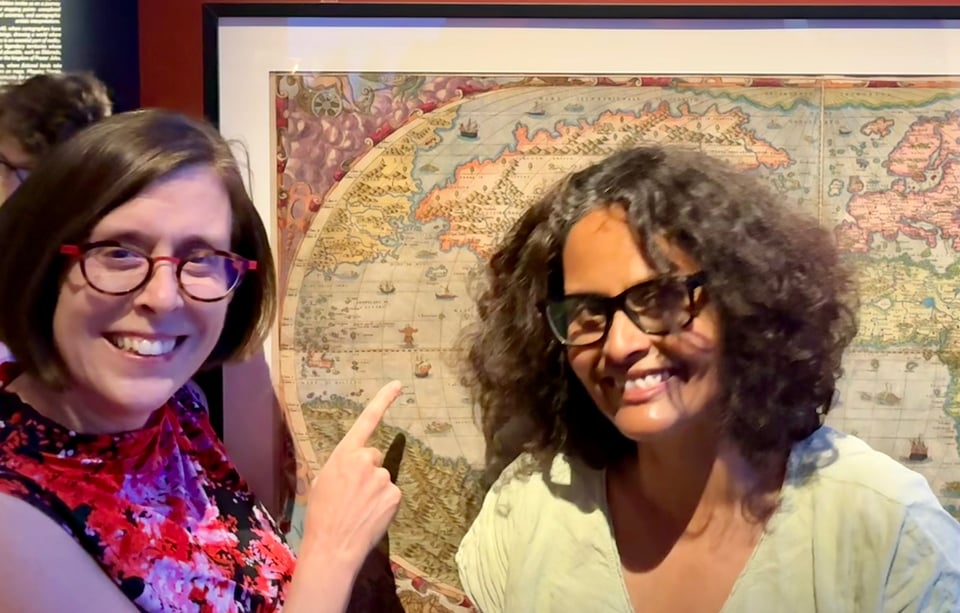

In a book on fish published in 1553, the French naturalist Pierre Belon had described and illustrated a marine creature he called a “pisces monachi” or monk fish (in a glorious, cerulean blue habit in the 1555 French edition). The monster made its way into a variety of books on the natural world, and onto this map, too.
Subscribe now for free for subscriber-only bonusesBlending categories
The work of British-Mexican surrealist, novelist, and feminist Leonora Carrington (1917-2011) is on show in a sprawling, enthralling, LUMINOUS retrospective that every SFF fan passing through Paris should try to visit (at the Musée du Luxembourg until July 19). This painting of a furry-costumed humanoid delicately feeding a bird that blends into a table is one of the quieter offerings:

The painting hangs towards the end of the show. For attentive viewers it contains a special treat. See those two kids peeking in at the back? You’ll have noticed them throughout the exhibition: they form the logo for kid-friendly labels:
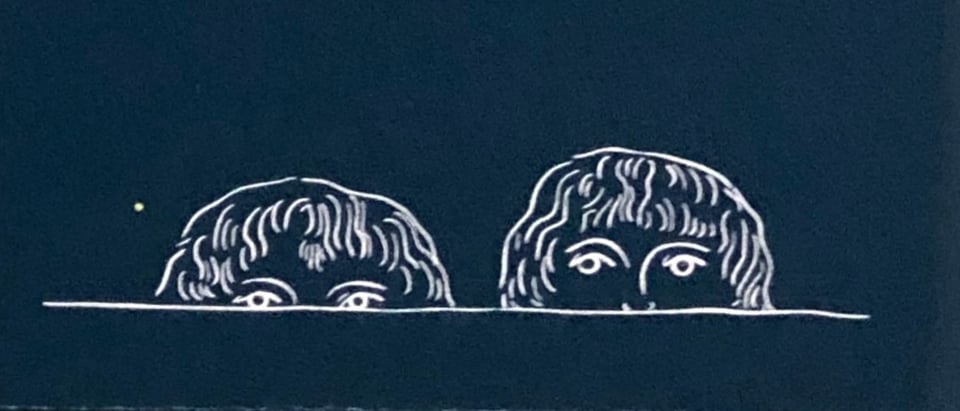
I found this a brilliant touch — once a curator always a curator, I guess.1
Carrington was living in France with painter Max Ernst when World War Two broke out. Ernst, as a German, was arrested for falling into the category of “hostile alien”. He was later released and fled to the United States with the help of Peggy Guggenheim.
Carrington managed to get over the border to Franco’s Spain where, let’s just say, her trials didn’t end. She eventually got to Mexico, where she would spend considerable portions of the rest of her life.
The exhibition includes a long, electrifying video interview with Carrington, in which she recounts, in a mixture of English and Spanish, aspects of her life. For a sense of her extraordinary work artwork since childhood, check out this official website. But if you’re passing through Paris and able to go to the show, it’s like travelling to other worlds.
Threading the world together with feathers
My fifth and final gem is a pair: two photographs from the first half of the twentieth century that reveal a thread that bound New York City to the rest of the world. They are on view in the plumes of paradise exhibition at the Musée du Quai Branly in Paris until Nov 8.

The men in the first photo seem to gaze at us through the camera lens, unconvinced that this encounter is going to end well for them. In their hands and on the floor of the verandah in which they sit are the extravagant plumes of birds of paradise, the fabled creatures whose feathers embellished many a costume for centuries.
In the early the twentieth century the global traffic in birds of paradise linked the labour of people in southeast Asia to that of these workers in what one might call a featherwork sweatshop in New York:

These serious-looking children and young women are trying to dig themselves out from under waves of bird-floof.
In a smart curatorial decision, these photos are displayed right next to each other in the exhibition. The pictures were taken half a world apart. Yet the underpaid, perhaps coerced, workers in each were both essential for the haute-couture world of the super-rich, in and beyond the Gilded Age of plumed outfits at cocktail parties.
Whether or not they knew it, the workers in these photos had shared interests: flourishing, or even just staying alive, in a globally connected, extractive economy in which none of them fully counted as human.
Even in that wondrous city of opportunity, New York City, this was an era when being Irish, or from southern or eastern Europe, or being Jewish, pushed a person out of the category of whiteness. If you were neither white, nor male, nor wealthy, you could forget about counting as a person whose flourishing mattered as far as most rich white elites were concerned.
This week one of the nastiest people on earth became a trillionaire on paper on the back of exploiting the planet and the rest of us, one way or another. Worker solidarity across race, class, gender, sexuality, embodiment, and nationality has never been more important.
Follow the money. And dissect and re-frame those monstrifying stories with which the super-rich and their minions try to force the rest of us to monstrify one another.
I worked as a Curator in the British Library Map Library, just before and during my PhD. Here’s an earlier newsletter essay about how grad student basement adventuring at the BL taught me why LLM-based genAI can only ever be garbage. ↩


Add a comment: